Nanny-camera SD card
Fool Me OnceThe Nanny-camera SD card is the removable storage at the center of a chain of observation, suspicion, and deception. Given to Maya Stern by Eileen Finn as part of a camera disguised as a digital picture frame, it seems to make private footage conveniently retrievable. But its images do not provide a simple record of what happened: a missing card prevents Maya from showing Roger Kierce what she saw, and the later explanation reveals that footage associated with the card was deliberately staged and altered. The device’s movement from household safeguard to disputed evidence and public broadcast makes it a small but consequential instrument in the story’s changing struggle over who can see, keep, and control an image.
Design and Domestic Use
Eileen gives Maya the disguised camera in the aftermath of Joe Burkett’s murder. The frame appears to be an ordinary container for family photographs, while its concealed camera can record activity in the room. Eileen also supplies an SD reader that connects to a computer through a USB port, giving Maya a straightforward way to retrieve the recording without needing a built-in card reader.
The card has 32 gigabytes of storage, which Eileen says should be sufficient for several days. A motion detector limits recording to periods when movement occurs, rather than capturing an empty room continuously. Eileen’s instructions make the system sound controlled and routine: Maya can remove the card at the end of the day, put it in the reader, and view the resulting video on her computer. In that arrangement, the SD card is both the camera’s storage and the practical link between concealed observation and a visible playback screen.
The frame’s ordinary appearance is part of that operation, but it also makes the device conspicuous to someone who knows the household. Maya considers whether Isabella might question why a new frame appeared just after the funeral and why it was already displaying family photographs. That possibility turns concealment into a source of anxiety: the camera is hidden from view as a camera, but its arrival may itself draw attention.
Playback and the First Suspicion
When Maya inserts the card into the reader and starts playback, the motion-triggered recording begins as Isabella walks past with coffee in a mug fitted with a protective lid. Isabella picks up Lily’s stuffed giraffe and moves out of the frame. The domestic details initially suggest ordinary caregiving, and the recording system seems to be performing the limited task Maya expected of it: showing her activity in the room when she is not watching directly.
A later view is blocked. Maya first considers whether Isabella’s body is covering the lens, but the visible colors do not fit that explanation. Isabella had worn a red blouse the previous day; the obstruction now appears green, and Maya judges that Isabella is too short for her back to cover the camera in the way shown. The image therefore offers a clue without immediately explaining itself. Maya’s concern depends on what the frame records, but also on the limits of that view: color and obstruction prompt suspicion, while the camera cannot yet establish for her who or what is in front of it.
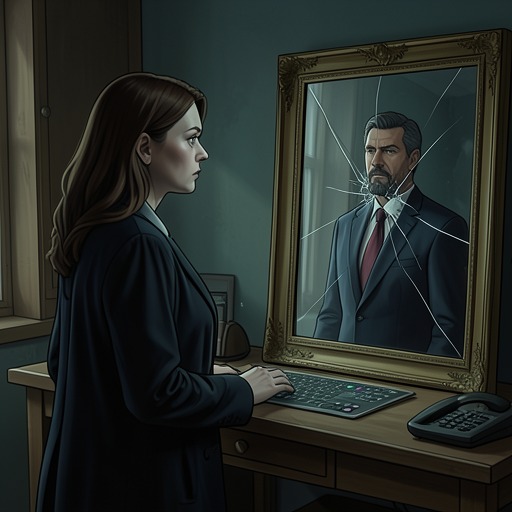
Maya later tells Roger Kierce that she saw a man on the footage. When she tries to demonstrate the recording on her laptop, however, the SD card is gone. She checks the USB port, then the surrounding area, and concludes that Isabella must have taken it. The absence changes the card from a convenient playback medium into missing evidence: Maya has a claim about what the video showed, but cannot immediately put the recording in front of Kierce. She weighs whether to tell him, recognizing that withholding the missing card could create problems if the matter resurfaced, and finally discloses that Isabella took it.
Removal, Staging, and Return
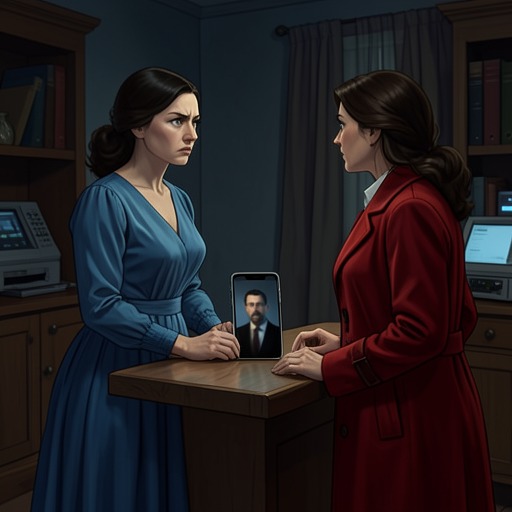
The card’s disappearance is connected to Isabella’s flight after she pepper-sprays Maya. Maya confirms that the missing item is the SD card and repeats that the video contained a man. The subsequent explanation changes the meaning of both the recording and its absence. Hector says that he dressed as Joe and allowed the nanny camera to record him. He then took the SD card back to Farnwood, where the family had a CGI specialist alter the material. About an hour later, Hector returned to the house with the card, and Isabella put it back into the frame.
This account reveals a deliberate chain of handling rather than an unbroken record: a person performed for the camera in disguise, the card was removed from the house, the family arranged for the footage to be altered, and the card was returned. The apparent image of Joe alive was therefore not reliable proof that he had appeared as himself. The card’s physical return did not restore the footage’s evidentiary integrity; instead, the images could be presented as a spontaneous observation while concealing the preparation behind them.
Isabella explains that she recognized the picture frame as suspicious because it appeared suddenly after the funeral, already loaded with family images, in a home where Maya did not display photographs of Lily or hang up her artwork. Her explanation gives the frame a double role: it concealed a camera from an uninformed observer, but its abrupt presence alerted Isabella. The storage medium could be removed and carried away, yet the device’s visible surroundings had already made the surveillance legible to someone paying attention.
Security and Control of Images
Eileen’s experience further complicates the assumption that a camera recording to an SD card is isolated from outside access. After receiving anonymous photographs taken inside her home, including images of her children and of herself after exercising, she identifies Robby as the likely source. She had believed that her nanny cameras were not connected to the web because they used SD cards. She then recognizes that cameras can be hacked and regrets not having set up security measures. Her account does not make every recording from Maya’s device false, but it shows why removable storage alone cannot guarantee privacy or control over the images a camera produces.
The different episodes place control at several points in the recording chain. A camera captures a view; a motion detector determines when it starts; a person can remove the SD card; a computer can display its contents; and someone with access to the device or network may acquire or manipulate images. The story offers no independent authentication procedure that resolves those vulnerabilities. Instead, confidence in a picture depends on learning who handled it and under what circumstances. The card’s physical presence is not the same as proof that the footage is unaltered.
From Private Recording to Public Feed
At Farnwood, the nanny-camera setup is ultimately used for a purpose opposite to its original domestic concealment. On Maya’s instructions, a person working with Corey Rudzinski arranges a live feed using the camera. Viewers can watch what happens inside the Burkett house that night as it happens. The camera that began as a means of observing household activity without attracting notice becomes a means of making events visible to a large audience.
That broadcast helps turn CoreyTheWhistle into a much larger platform. Its wider consequences include giving frightened or powerless people the courage to come forward and contributing to the exposure of corrupt governments and businesses. Yet the narrator also recalls a personal grievance because the platform had previously published the military mission. The card and camera therefore sit at a point of tension between surveillance and disclosure: the same kind of technology that can invade a home, disguise a staged image, or compromise private footage can also be redirected toward public scrutiny. Its significance lies not in guaranteeing truth, but in showing how much depends on who controls the recording and where the images go.